
Product Context Intelligence: How global pharma enterprises connect fragmented product data

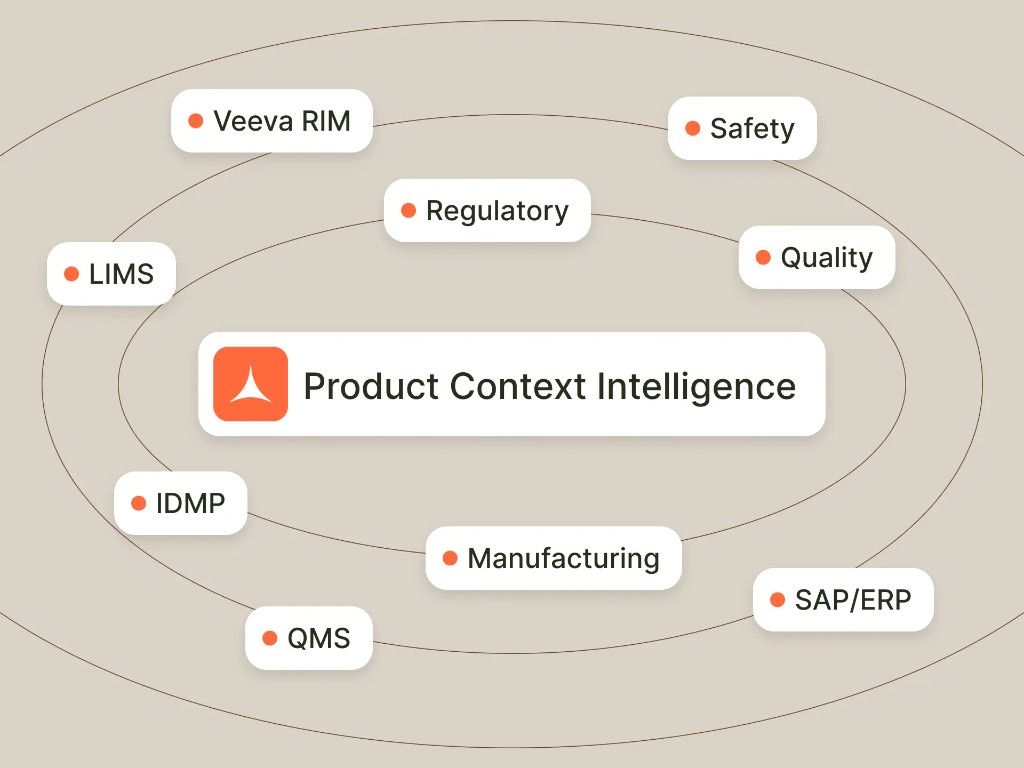
Every team works with a fragment.
In pharma, everything connects to the medicinal product. But the product no longer lives inside one company. It spans systems, partners and authorities. Enterprise software was built around functions, so each system holds its own piece of the truth: the formulation in one, the regulatory dossier in another, the manufacturing site in a third.
So how do you answer a question about the product across the whole pharma value network, when the product crosses every function and the systems that describe it do not?
Today, mostly by hand. That is why high-stakes decisions still carry doubt they should not. The record in front of you may be correct and still incomplete. The next team may be looking at a different fragment of the same product. Trust here is not a feeling. It is knowing that what you see is complete, and that the next team sees the same.
What Product Context Intelligence is?
Product Context Intelligence (PCI) is the enterprise layer that connects product identity, trusted data and context across systems and organizations, and turns them into reusable intelligence for people, applications and AI.
Product means the medicinal product itself: the thing every function, partner and authority is actually talking about, even when each of them names it differently.
Context means what that product is, how its parts relate, and what a change means. Data tells you a record exists. Context tells you what it means for the products, sites and markets it touches.
Intelligence means that context can be used again by anyone who needs it: a regulatory scientist preparing a submission, a commercial lead asking which markets are affected, an application already running in your landscape, or an AI agent that has to act and cannot guess what the product is.
How the layer works
PCI is not another database your teams have to feed, and it does not replace the systems that already work. Each system keeps its own language. The layer translates between organizations, standards and systems, so that what lies fragmented finally connects and makes sense.
Underneath, every record is uniquely identified, standardized, matched and aligned, so it can be traced, verified and defended. That is what allows a change in one place to be followed to everything it touches.
The foundation is open standards such as IDMP (Identification of Medicinal Products), the global standard for describing a medicinal product and its relationships. Accurids co-developed the official IDMP Ontology with the Pistoia Alliance and is its official implementation partner.
One change, followed everywhere
Visualize a marketed product. A requirement on one of its ingredients changes, and five teams respond in five systems:
- Quality updates the risk assessment in the quality management system.
- The laboratory confirms the test method in LIMS.
- Manufacturing confirms the material specification in ERP.
- Regulatory checks it against the registered specification in the dossier.
- The supplier sends a revised specification, pending approval.
Each update can be right on its own. The enterprise question is a different one: which products, submissions, markets and packs does this change reach?
That question is harder than it looks, because an ingredient rarely belongs to one product. It is often used in other products, registered in other submissions and sold in other markets. No single system holds that chain. Without PCI, someone exports from each system and reconciles by hand, every time. With PCI, the product already has a persistent identity and its relationships are already connected, so the change can be traced to every product, submission, market and pack it affects.
That is Product Context Intelligence in daily work: the product becomes visible across systems, and the enterprise can understand it, act on it and trust the decision.
What this changes for the business
Change impact is one example. The same context serves the whole lifecycle: development and launch, regulatory submissions, quality and supply. Impact assessments that took weeks of manual reconciliation take hours. New medicines reach the market sooner because development, regulatory and manufacturing work from the same picture.
The value compounds because the layer is reusable. Built once, on the systems already in place, it lets every function ask its own question of the same product.
That is also why AI belongs here. AI can retrieve data, but it needs product context to reason. An agent can run an impact assessment or draft an action plan only when the context underneath it can be traced, verified and defended.
Pharma enterprises that build this layer will not simply have one more system. They will be able to trust a product decision at the moment it has to be made: in development, in a submission, at the plant, in the market, all the way to the patient. Across the value network, people, applications and AI act on the same product.
Accurids. Trust in Every Product Decision.
Read more
.webp)
.jpg)
From Fragmented Data to a Unified Backbone. In Months, Not Years.
.png)